
When people talk about “Dollar for Dollar” in the United States, it usually means they expect to double whatever money they put into a business or investment. In Nigeria, many people carry the same thinking—“Naira for Naira.” Some even go as high as 1 Naira for 2-5 Naira. The idea is simple but very misleading: if I invest ₦100, I should get ₦100 profit back immediately. The question is and has always been, what sort of business really gives such a return?
The truth is that business doesn’t really work like that.
Real business is about long-term growth, patience, and steady profit. It just goes to say that those who build over time—long-term businesses—are the real masters of the business world.
Let’s explore why this “naira for naira” mentality is making it so hard for Nigerians to raise capital for business.
Table of Contents

Why People Expect a Naira for a Naira
In Nigeria, life is hard. Nigeria is a third-world country anyway, so it is expected. Inflation keeps rising, salaries remain low, and people want to see instant results when they put money somewhere.
Is this really the issue? Because way back in the day, when the nation was deemed as being prosperous and better compared to now, people still had this mentality. I know this because I have been around for a while. I think some aspects of our culture—especially in the south and western parts of Nigeria—are responsible for this. The Northern Muslim-dominated part of the country is not as greedy and eaten up by such a mentality. The reason why at the marketplace people from all parts of Nigeria like to buy from the Mallam or Aboki.
This is why many investors say, “If I give you ₦200, I expect ₦200 profit in return.” The problem is that no real, sustainable business grows that fast.
It’s like planting corn today and expecting to harvest tomorrow. That’s not how nature—or business—works. The are other reasons why the prices of products sold online are up in Nigeria, details of this can be read on the post via the link.

Why the Wealthy Think Differently
Wealthy people have a totally different mindset. Instead of expecting “naira for naira,” they think about steady, small returns that build up over time. It is said that fortune favour the brave but being brave is not all about taking unnecessary risk. Safe investments, small margins, consistency and judicious spending is the best way to build wealth.
For example, if they invest ₦1 million and earn 10% profit (₦100,000) in three months, they are satisfied. Why? Because they know that small, consistent profits are safer and lead to bigger wealth in the long run. Also, lower interest rates come with the assurance of a secured capital, which means that you will hardly loss your money.
This is what separates business builders from quick gamblers.

A Kobo on a Naira Is Still Good Profit
A wise businessman knows that even one kobo profit per naira is growth.
Imagine a seller buys a pen for ₦100 and sells it for ₦110. That’s just ₦10 profit. Sounds small, right? But if the seller sells 10,000 pens, that’s ₦100,000 profit.
The sales rate is always faster and the quantity is often larger when it when the pricing is fair and affordable. If a business is dealing in luxury goods, the pricing and profit margin is different from normal goods.
Lesson: It’s not about one-time huge gains; it’s about multiplying small profits over many sales.


How the Naira for Naira Mentality Scares Entrepreneurs
Entrepreneurs don’t like pressure. When they hear people demanding “double returns” in a short time, they run away. You know. It is funny how most of the people who always demand double return for a penny are not into running a business and cannot do the business for themselves. They just think about themselves and the money that they are putting in. They also have an illusion that business brings in over 100% returns yet they would not do the business themselves to make all the money for themselves.
This mentality makes it harder for serious entrepreneurs to find good investors who are willing to wait for gradual growth. Instead, many potential backers turn to safer options like real estate, bonds, or foreign investments. If you belong to this category, repent today. Change you mindset.
Advantages of Understanding “Naira for Kobo” Profitability
When you understand that profit is about Kobo on each naira, not doubling naira for naira instantly, you open the door to long-term success.
- You attract serious investors who believe in growth.
- You build trust with customers because your prices are fair.
- You can survive market challenges because you’re not desperate for “sharp money.”
- This mentality builds sustainable businesses that last for years.

The Disadvantages of Quick Money-Making Investments
Everyone loves quick money. Who doesn’t want to “cash out” overnight? But here’s the problem: quick money-making investments are often risky and short-lived.
Think about Ponzi schemes like MMM or fake crypto trading promises and the most recent one CBEX. They give the illusion of instant doubling of money, but most times, people end up losing everything. Businesses that focus only on fast profit hardly last. Well, risk taking is a rewarding adventure when it rewards but the success rate is too low to bank on it. Why not invest wisely with minimal risk and take good profits over time?
Raising capital from friends and family is the toughest because the are the ones with the money to invest without collateral. Yet they are the ones most commonly into the Ponzi idea of double or nothing when it comes to returns on investment.
Lesson: When you chase quick gains, you trade your future stability for temporary excitement.

The Role of Business Education
One big problem is lack of business education among Nigerian and African youth.
Many young people think business is about “cash out fast, flex, and move on.” But real business requires:
- Patience
- Planning
- Consistency
- Discipline
Without this education, the cycle of failed investments and disappointment continues.
Losses Common to the “Naira for Naira” Ideology
Here’s what usually happens when people expect quick double returns:
- Failed businesses because unrealistic profit targets force wrong decisions.
- Loss of investor trust when promises cannot be met.
- Scams thrive, because greedy people fall for “too good to be true” offers.
- Overpricing, as sellers inflate prices just to meet “naira for naira” expectations.
In the end, both sellers and customers lose.
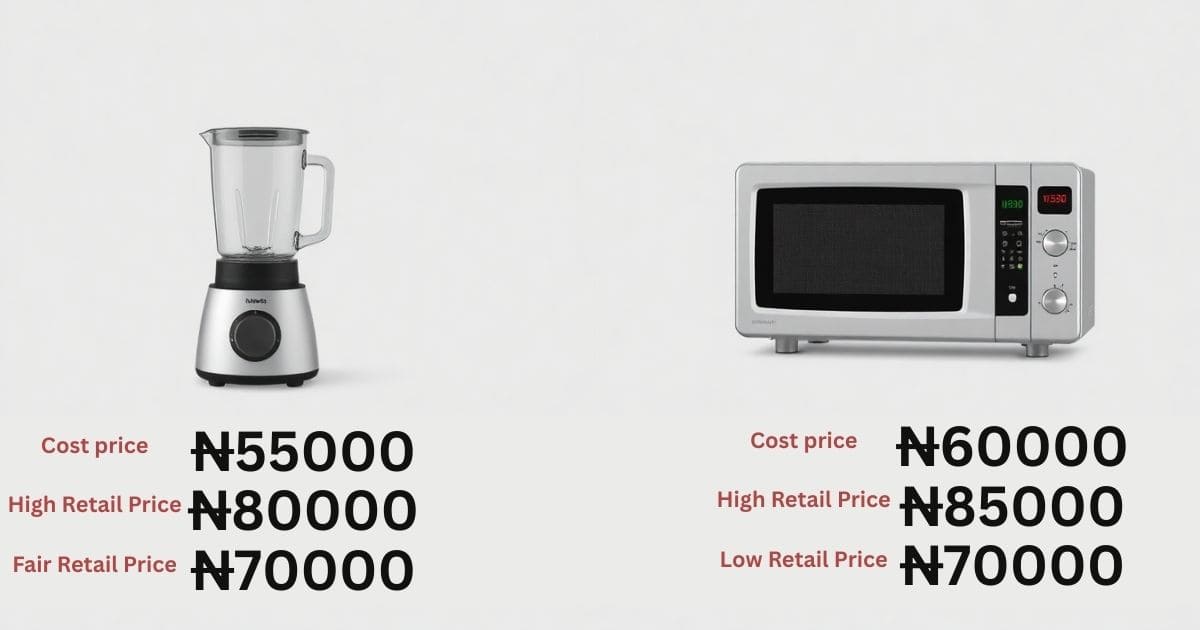
How This Mentality Affects Pricing
Ever wondered why some products in Nigeria are unreasonably expensive? It’s because many sellers think: “I must double my money at once.”
So, if they buy shoes for ₦5,000, they want to sell them for ₦10,000. While that looks like great profit, it actually pushes customers away.
A smarter seller would sell the shoes at ₦6,500 or ₦7,000, make smaller profit, but sell more shoes overall.
A Practical Example of the “Kobo for Naira” Concept
Let’s say a seller buys 500 wristwatches at ₦2,000 each.
- If they sell each for ₦3,500, they make ₦1,500 profit per watch. But maybe they only sell 100 watches because customers think it’s too expensive. Total profit = ₦150,000.
- If instead, they sell each for ₦2,800 (just ₦800 profit per watch), they might sell all 500 watches. Total profit = ₦400,000.
Lesson: Small profit + big volume = big success.
Conclusion
The “Naira for Naira” mentality is holding Nigerian businesses back. It scares entrepreneurs and investors, inflates prices, and destroys long-term growth.
The truth is, real wealth is built through patience, steady profits, and fair pricing. A kobo on each naira may look small, but when multiplied across thousands of sales, it creates sustainable wealth. Though the devaluation of our currency over time has led to the elimination of the Kobo, this article is aimed at enlightening you on the investment and profit mindset of the entrepreneur and the investor in the country.
If Nigerians can move away from “quick money” thinking and embrace
long-term growth, raising capital will no longer be such a challenge.
These would Interest you!
- 7 Reasons Why Product Replacement is a Major Challenge for Nigerian Sellers
 Product replacement is a critical issue that many Nigerian sellers face every… Read more: 7 Reasons Why Product Replacement is a Major Challenge for Nigerian Sellers
 - ALL TERRAIN MULTIPURPOSE STAIRS CLIMBING CART
 What is the Difference Between a Cart and a Trolley? Key Differences… Read more: ALL TERRAIN MULTIPURPOSE STAIRS CLIMBING CART
 - Clothes Dryer: The Foldable Clothes Dryer
 The Need for a Clothes Dryer Reasons Why You Need a Clothes… Read more: Clothes Dryer: The Foldable Clothes Dryer
 - How to Source for the Best Products in China
 China has become a global hub for product manufacturing, offering a wide… Read more: How to Source for the Best Products in China
 - LOAN APPS IN NIGERIA: OUR OWN VERSION OF CREDIT CARDS – ARE THEY GOOD FOR BUSINESS OR NOT?
 Can These Loans Be Used as a Source of Funds and Capital… Read more: LOAN APPS IN NIGERIA: OUR OWN VERSION OF CREDIT CARDS – ARE THEY GOOD FOR BUSINESS OR NOT?
 - PAYMENT ON DELIVERY VS PAYMENT BEFORE DELIVERY: WHICH ONE IS BETTER?
 What Is Payment on Delivery (POD)? Advantages of Payment on Delivery Advantage… Read more: PAYMENT ON DELIVERY VS PAYMENT BEFORE DELIVERY: WHICH ONE IS BETTER?
 - Safe Shopping on Facebook: A Step-by-Step Guide to Verifying Authentic Products
 Learn how to avoid shopping for low quality products on social media and also how to avoid falling in the hands of scammers… read more now.